



An employee feels faint during a shift.
Their coworkers quickly look for someone trained in first aid. They know the company has first aid attendants, but no one knows who is working today.
The first aid kit is in a locked office, and the supervisor does not know where to find the intervention log.
Fortunately, emergency services arrive quickly.
But this situation raises an important question: is your company truly prepared to respond when an emergency occurs?
In Quebec, employers must meet several workplace first aid requirements.
Having a few employees attend a training course is not enough. Employers must also organize coverage, provide the necessary equipment, make essential information accessible and plan how incidents will be handled.
Workplace first aid rests on three essential elements: qualified people, accessible equipment and an organization that can respond quickly.
Here are the main employer obligations to know and the checks to carry out in your workplace.
What are employers required to do about workplace first aid?
In Quebec, the Regulation respecting minimum standards of first aid and first aid services sets out the main requirements for establishments, construction sites and certain specialized workplaces.
The CNESST oversees the workplace first aid program and provides information to help employers apply these rules.
As a general rule, employers must:
Ensure the required minimum number of qualified first aid attendants are present during working hours.
Designate people whose duties allow them to respond quickly.
Ensure attendants receive the required training and maintain valid certification.
Post the names of first aid attendants in a visible location.
Provide first aid kits suited to the risks and workforce size.
Enable first aid to be administered and make arrangements to care for injured workers.
Document first aid interventions as required.
Some activities are also subject to additional provisions.
Consult the Regulation respecting minimum standards of first aid and first aid services
How can employers put these obligations into practice?
1. Ensure qualified first aid attendants are present during working hours
The first responsibility is to plan for the appropriate number of first aid attendants.
For establishments generally covered by the regulation, the minimum thresholds are as follows: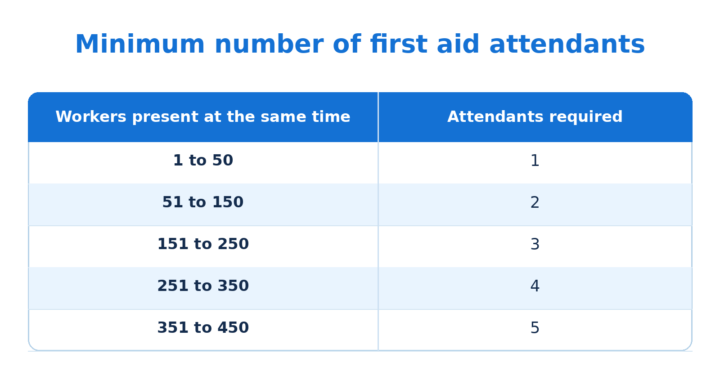
Starting at 151 workers, one additional first aid attendant is required for each additional group of 100 workers or fraction of a group.
The calculation must consider the number of workers present at the same time and each work shift.
For example, a business with 80 employees on the day shift and 25 on the evening shift would normally need two first aid attendants on the day shift and one on the evening shift.
Coverage needs may also change when two shifts overlap.
The rules for calculating coverage differ for construction sites and forest management work. For forest management, the minimum number of first aid attendants present at the same time is determined as follows: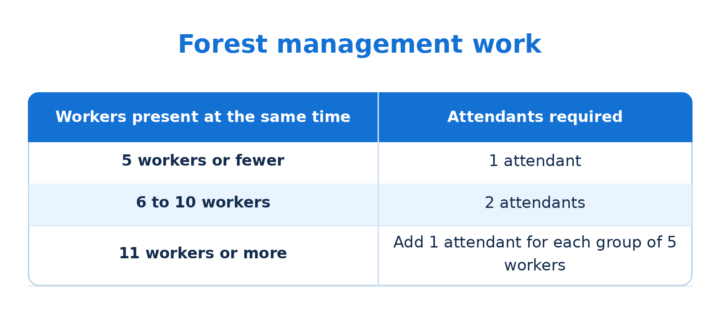
These thresholds refer to the total number of first aid attendants. Additional forest-specific training requirements also apply, depending on team size.
When 10 or more workers are present at a forest worksite, at least one attendant who has completed the specialized 40-hour Forest First Aid training must be present at all times. One additional forest first aid attendant is required for each additional group of 10 workers. The employer must also train at least one additional forest first aid attendant beyond the minimum to cover absences.
When nine or fewer workers are present, an attendant with the specialized 40-hour forest qualification does not have to be on site. However, the employer must ensure effective communication with a forest first aid attendant, nurse, paramedic or physician who can give first aid instructions to people at the worksite. Calling 911 does not replace this obligation.
Source: CNESST, “Workplace first aid training” — https://www.cnesst.gouv.qc.ca/fr/prevention-securite/secourisme-en-milieu-travail/formation-secourisme-en-milieu-travail
For ordinary establishments, the regulation also provides certain exclusions involving remote workers and people present for less than 30 minutes.
Employers must therefore plan for actual coverage on every shift, rather than simply keeping enough training certificates on file.
2. Designate first aid attendants who can actually respond
Having someone with a valid certificate on site does not automatically guarantee that first aid can be provided quickly.
Consider a business that names as its only first aid attendant an employee responsible for an operation that cannot be stopped without creating another hazard.
Even with valid certification, that employee’s regular duties could prevent a timely response.
Employers should choose people whose normal duties do not interfere with the speed and effectiveness of first aid.
The layout of the workplace also matters.
In a workplace spread across several buildings or a large area, it may make sense to designate attendants in different sections.
The regulation establishes a minimum. The realities of the workplace may justify training more people.
Backups are important too.
When an attendant is absent, on vacation or assigned to another shift, the organization must still meet the applicable requirements.
An availability schedule and certification register can make this much easier to manage.
3. Enrol employees in the appropriate training
An employee who has taken a general CPR course does not necessarily hold the qualification required to serve as a workplace first aid attendant.
The standard regulated workplace first aid course lasts 16 hours.
It must be delivered by a training organization recognized under the workplace first aid program.
Where the relevant course offers this format, employers may choose hybrid training: self-paced online theory followed by in-person practical training. This option makes scheduling easier while preserving the required hands-on exercises.
The course develops the skills needed to assess a situation, secure the scene and provide appropriate first aid.
Participants learn cardiopulmonary resuscitation (CPR), how to use an automated external defibrillator (AED), how to respond to certain injuries and what to do when someone becomes ill.
Santinel is a CNESST training provider and offers Workplace First Aid training, courses with marine and forestry components, and the specialized 40-hour Forest First Aid course. Santinel also offers the annual eight-hour Forest First Aid refresher courses (Levels 1, 2 and 3), which follow a three-year cycle.
For organizations training regular attendants, Santinel’s Workplace First Aid course to build the skills required for the role.
However, employers must check the requirements that apply to their specific environment. Companies working in forests or remote areas, for example, may need specialized training.
4. Track the validity of first aid certificates
Workplace first aid attendant certification is valid for three years.
When the certificate expires, the worker must take the full 16-hour Workplace First Aid course again. A short refresher or update course is not accepted as a substitute for renewing this certification. This should not be confused with the annual refresher training required for specialized forest first aid.
This expiry date is therefore important to track.
Imagine a company with two attendants on its day shift.
Both certificates expire in the same month.
If the full training is not scheduled before the certificates expire, the company could be left with insufficient first aid coverage.
To avoid this, keep a register that records: This lets employers schedule training before expiry and reduce the risk of a gap in coverage.
5. Pay first aid attendants during training and interventions
This is an obligation worth highlighting.
Designated first aid attendants are considered to be at work when taking their training and when performing first aid duties during working hours.
Employers must therefore pay them for these periods.
Employers must also cover the costs for which they are responsible to establish and maintain workplace first aid services.
Subsidies may be available for certain courses, depending on the applicable program and eligibility requirements.
Funding arrangements depend, among other things, on the industry and the number of people trained.
Do not assume that every training place is automatically subsidized.
Employers should confirm the conditions with their training provider before scheduling registrations.
For details, consult the official information on workplace first aid training funding
6. Clearly post the names of first aid attendants
Workers must be able to quickly identify the people qualified to provide first aid.
Employers must post attendants’ names somewhere visible and easy to access.
The information must also be useful in practice.
At a business with several shifts, a list of all certified employees can be difficult to use if it does not indicate who is normally on site.
You might, for example, organize the names by department or shift.
The information may also appear in internal tools, provided the regulatory posting requirement is still met.
Update the list whenever employees leave the company, change roles or obtain certification.
A notice that still lists someone who left months ago will not help anyone during an emergency.
The goal is simple: employees should immediately know whom to contact.
7. Provide suitable first aid kits
First aid attendants also need the right equipment to respond.
Employers must provide an adequate number of first aid kits.
The kits must be accessible, portable, available during working hours and located as close as possible to the areas concerned.
Their contents must meet CSA Standard Z1220 for workplace first aid kits.
There is no single kit that automatically meets the needs of every workplace.
An office and an industrial workshop do not necessarily face the same level of risk.
The type and quantity of supplies should therefore be determined based on workplace hazards and the number of workers on each shift.
The CNESST distinguishes between basic kits for low- or moderate-risk workplaces and intermediate kits for higher-risk settings.
Personal first aid kits may also be required in specific situations, including isolated work without access to a kit and certain vehicles used to transport or move workers. The required kit depends on the working and transportation conditions. See the CNESST information on first aid equipment: https://www.cnesst.gouv.qc.ca/fr/prevention-securite/secourisme-en-milieu-travail/materiel-premiers-secours
Kit contents must also be checked regularly.
For example, used compresses must be replaced, as must supplies that are damaged, dirty or expired.
Unlike first aid certificates, kits do not have to be replaced automatically every three years.
Their condition and contents are what need to be checked.
To determine the appropriate supplies, consult the first aid equipment requirements
8. Provide a first aid room when required
Some workplaces must also provide a room for first aid attendants to use.
As a general rule, this applies to establishments with more than 100 workers, as well as certain construction sites under the applicable provisions.
The room must be accessible during working hours and meet specific conditions.
In particular, it must be clean, properly ventilated, well lit and heated.
It must also contain the equipment required by regulation, including something that allows a person to lie down comfortably.
Having a first aid room does not replace other obligations, including accessible kits and on-site attendants.
Think of the room as an additional resource for providing first aid when needed.
Businesses approaching or passing the 100-worker threshold should review this requirement when planning their facilities.
9. Plan communications and emergency procedures
Even when enough first aid attendants are on site, employees must be able to contact them quickly.
In a large warehouse, for example, an accident could occur far from the administrative offices.
If nobody knows how to alert an attendant, help could be delayed.
A simple procedure can make all the difference.
Who should be notified when an accident happens? How can an attendant be reached? Who calls emergency services when necessary? How can responders gain access to the injured worker?
These details must be adapted to the workplace.
The procedure does not have to be complicated.
But employees should know what to do and how to obtain help.
Some environments, especially remote or hard-to-reach worksites, may require additional measures.
The company must make sure its communication and response arrangements fit the actual risks and conditions.
10. Arrange care for an injured worker
When an accident occurs, employers must ensure first aid can be provided.
They must also take the steps needed to obtain appropriate medical care when the situation requires it.
In some cases, this may include transporting the worker to a healthcare facility.
The regulation requires the employer to cover applicable transportation costs when an injured worker must be taken from the workplace to a healthcare facility.
First aid responsibilities must also be distinguished from other obligations related to occupational injuries.
For example, an accident may trigger further administrative steps when an employee needs medical care or time off work.
The CNESST explains the employer’s steps following a workplace accident
The goal is to ensure prompt care for the injured person while meeting the obligations arising from the incident.
11. Maintain an accident, incident and first aid register
When an attendant provides care to an injured worker, the relevant information must be entered in the designated register.
The register may include the date and time, people involved, type of injury or illness and first aid given.
It provides an important record of interventions.
It can also help a business identify situations that deserve attention.
For instance, repeated similar injuries during the same task may reveal an ongoing hazard.
It is important to distinguish events that require a register entry from near misses with no injury, which are still worth reporting as a prevention practice.
Confidentiality must also be protected because the register contains personal information.
Attendants should understand their recordkeeping duties, while employers should make appropriate arrangements for access to and use of the register.
12. Adapt first aid arrangements to specialized work
The general rules for establishments do not automatically cover every situation.
Construction sites, for example, are subject to specific provisions concerning the number of attendants and the organization of first aid.
Forest management work also has specific requirements concerning the number of attendants, specialized training, equipment and communication in remote locations.
The standard 16-hour course is therefore not always the only training to consider.
Before scheduling training, employers should review their activities and any special regulatory requirements.
This is particularly important for companies operating in different environments or using mobile teams.
Checklist: is your business meeting its first aid obligations?
Use this simple checklist to review your arrangements. This checklist is a general self-assessment tool and does not replace the regulatory requirements specific to each industry.
It can, however, be a useful starting point for discussions between human resources, OHS teams and operations managers.
The key is to identify gaps before an accident happens.
How can you organize workplace first aid effectively?
For many employers, understanding the rules is not the hardest part.
The challenge is maintaining compliance over time.
Employees change shifts, staffing levels rise, attendants leave and certificates expire.
It helps to assign one person to coordinate the administrative tasks.
That person could manage the certification register, book training, check staffing by shift and keep attendant lists up to date.
Supervisors can also help confirm which attendants are present on each shift.
For kits, someone can be responsible for checking supplies and replacing items that have been used.
This avoids leaving responsibilities scattered across the organization with no clear follow-up.
It is also wise to reassess needs when the company grows significantly or changes its schedules.
Organized workplace first aid means being ready before an emergency
Workplace first aid is about more than holding a few training certificates.
Employers must ensure qualified attendants are present, provide the necessary equipment and organize measures that enable a quick response.
They must also keep certifications current, plan backups and ensure employees know how to get help.
These obligations can seem extensive.
But when they become part of everyday operations, they are easier to manage.
Above all, they reassure workers that trained people and the means to respond will be available if an accident or medical emergency occurs.
Need to train new attendants or renew your team’s certifications? Explore Santinel’s 16-hour Workplace First Aid training.
Our team can help coordinate registrations around your company’s needs and work schedules.


