


You are walking through your workplace with a supervisor. In the warehouse, you notice forklifts operating close to pedestrians. Farther along, an employee mentions a recurring manual-handling issue. In the office, a manager says her team has been experiencing an unusually heavy workload.
You have already identified several hazards. But what should you do with that information?
This is often where things get complicated.
Observations end up in different documents. Some appear in meeting minutes, while others remain only in managers’ memories.
A few months later, when it is time to review prevention efforts, it becomes difficult to determine which hazards were assessed and which measures were actually implemented.
In Quebec, employers must identify and document hazards in their workplaces, whether they are subject to a prevention program or an action plan. Hazard analysis and prioritization must then reflect the requirements applicable to each establishment.
Fortunately, this process does not have to be complicated. The goal is to keep a clear record of hazards, where they occur, planned actions and follow-up measures.
Here is how to get started.
What Exactly Does the CNESST Require?
According to the CNESST, hazard identification involves recognizing hazards and risk factors that could cause a workplace accident or occupational disease and determining where they are present.
Documentation must reflect the establishment’s actual activities.
Whether an establishment is subject to a prevention program or an action plan, it must identify the hazards present in its workplace. Analysis then helps assess their significance and guide prevention measures. Formal prioritization of risks is notably among the requirements applicable to a prevention program.
Under an action plan, identified hazards must also lead to concrete prevention measures and appropriate follow-up.
It is important to distinguish between identifying hazards, analyzing their significance and taking corrective action.
These steps are connected, but each answers a different question.
- Identify: What is the hazard, and where is it located?
- Analyze: How serious could the consequences be, and how frequently are workers exposed to the hazard?
- Correct: What measures will eliminate or control the risk?
- Monitor: How will you verify that these measures remain effective?
The CNESST outlines these steps in its official prevention approach.
Where Should You Start if You Have Never Identified Workplace Hazards Before?
Start with something simple: list the activities actually performed in your workplace.
Do not limit yourself to the departments on the organizational chart. Think about day-to-day tasks.
In a warehouse, for example, consider receiving, storage, order picking, equipment traffic and loading operations.
In a manufacturing facility, examine machinery, maintenance, cleaning operations, raw-material handling and production changeovers.
In a service business, consider workstations, travel, customer interactions and organizational factors that may affect psychological health.
Once you have listed these activities, it becomes much easier to identify situations that could cause an injury or health problem.
This step also helps you avoid relying solely on a generic checklist that may not reflect your workplace reality.
How Should You Collect Information About Workplace Hazards?
There is no single method that works for every workplace.
A workplace inspection can reveal many hazards, but it will not reveal everything.
Some problems arise only on an evening shift, during a particular maintenance operation or when machinery runs under unusual conditions.
That is why it is useful to involve the people who know the tasks best.
Supervisors can explain how operations are organized. Workers can describe challenges they encounter and situations that may not be visible during an inspection.
Accident reports, near-miss reports, inspection records and previously documented observations can also provide useful information.
Be sure to consider less visible risks, including exposure to certain contaminants, noise and psychosocial risk factors.
The goal is to gather enough information to understand when the risk arises and who may be exposed.
What Information Should Go Into an OHS Hazard Register?
An effective register does not need dozens of columns.
It should enable someone else to understand what was observed, why it poses a risk and what action is planned.
Here is a fictional example of a simplified hazard register.
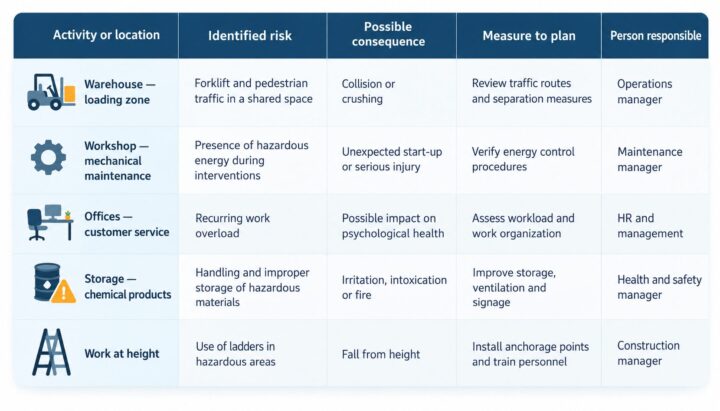
This table is a starting point. A more complete register would generally include the observation date, exposed workers or job roles, analysis findings when required, control measures, deadlines and follow-up actions.
For example, simply writing “forklift hazard” is too vague.
It is more helpful to specify that pedestrians must cross a forklift traffic lane to reach an order-picking area.
That detail makes the problem easier to understand and helps determine an appropriate measure.
How Do You Assess Severity and Frequency of Exposure to a Hazard?
Once hazards have been identified, analyzing them helps determine suitable prevention measures. This step is particularly important when setting priorities within a prevention program.
To assess an occupational health and safety risk, you can examine the severity of potential harm and how often workers are exposed to the hazard. Depending on the method used, other factors, such as the likelihood of an incident, may also be considered.
Consider two situations.
In the first, an employee occasionally moves a lightweight box in a well-designed workspace.
In the second, a technician must work near a moving mechanical component that could cause a serious injury.
Both tasks may involve risks, but they will not necessarily warrant the same level of urgency.
Risk analysis helps establish priorities.
Many organizations use a risk-rating matrix to compare hazards consistently.
However, the method must be adapted to the workplace.
Remember that some serious hazards require immediate action, regardless of the score assigned by an internal matrix.
A low risk rating is not permission to leave a dangerous situation uncorrected.
Do Psychosocial Risks Also Need to Be Documented?
Yes.
Since the modernization of Quebec’s occupational health and safety prevention system, psychosocial risks are explicitly among the risks that must be considered.
These include factors related to excessive workloads, insufficient support, certain situations involving violence or harassment, and other aspects of how work is organized.
Documenting these risks may require a different approach from the one used for physical hazards.
You cannot always identify a psychosocial risk simply by walking through a facility.
It is often necessary to gather input from workers and managers, examine working conditions and identify recurring situations.
For example, several employees may report that workloads become difficult to manage during certain times of the year.
The register should then describe the organizational risk factor and the work groups affected rather than unnecessarily recording personal or medical information.
Confidentiality is especially important throughout this process.
To learn more, read our article on preventing psychosocial risks and the role of managers.
Is Excel Enough to Document Hazard Identification?
Yes. An Excel spreadsheet or another electronic document may be suitable.
The CNESST does not require every business to use specialized software to document workplace hazards.
What matters is choosing a method that makes it possible to record, retrieve and update the information.
For a small or medium-sized business with a single location, a well-organized register may be entirely appropriate.
However, when several managers are involved, avoid having each person maintain a separate version.
One current version should be accessible to the people concerned, with clear responsibilities for making changes.
This tool is optional, but it can make the process easier by providing a structure for recording observations and planned measures.
Who Should Participate in Hazard Identification?
It may be tempting to assign the entire exercise to a single person responsible for OHS.
But that person may not be familiar with the details of every task.
A manager may know the formal procedures well, while an experienced worker understands what actually happens when production is under pressure.
Both perspectives matter.
The CNESST also provides for worker and worker-representative participation in prevention activities, depending on the mechanisms that apply to the establishment.
Where a workplace has a health and safety committee, observations and follow-up actions may form part of its work.
However, participation should not be reduced to simply signing a document.
The objective is to build an accurate picture of what happens on the ground and identify measures that will make a practical difference.
How Often Should the Hazard Register Be Updated?
A hazard identification exercise conducted three years ago may no longer reflect the reality of your workplace.
Equipment changes. Teams grow. New work methods are introduced.
The CNESST recommends reviewing the process regularly, including at least once a year and whenever a change could affect the hazards associated with a job.
Annual updates to a prevention program or action plan are also mandatory for establishments subject to these requirements.
In practice, however, you should not wait for the annual review when a new hazard emerges.
For example, if a company installs new machinery, reorganizes its warehouse or changes a team’s duties, the related hazards should be reassessed when the change occurs.
The same principle applies after an accident, a near miss or an observation that reveals a significant gap.
A register should reflect current conditions, not merely preserve a record of an assessment completed in the past.
What Mistakes Make an OHS Hazard Register Less Useful?
The first mistake is using descriptions that are too general.
“Fall hazard,” “chemical risk” or “workplace stress” does not always make it clear what needs to be corrected.
Describe the circumstances and the people who may be exposed.
Another mistake is identifying a hazard without planning follow-up action.
For example, a register may have indicated for two years that a traffic lane needs to be redesigned, yet no one is responsible and no deadline has been established.
The issue is known, but there is no way to confirm that it is being addressed.
Finally, some companies document only the most visible physical hazards and overlook less obvious exposures, including contaminants and psychosocial risk factors.
A useful register should cover the hazards relevant to the workplace, not just the easiest ones to spot.
How Can You Tell Whether Your Approach Is Complete Enough?
Choose a routine activity at your workplace and try to answer a few questions.
What hazards have been identified? Where are they located? Who might be exposed? How was their significance assessed when analysis is required? What measures have been implemented? Who verifies their effectiveness?
If you can readily find this information, your process is becoming a genuinely useful management tool.
If the answers are scattered across multiple documents or some measures are outdated, there is probably more work to do.
The goal is not to produce the longest possible register.
It is to have a tool that supports better decisions and helps track the actions that need to be taken.
Not Sure Whether Your Hazard Identification Is Complete?
In some workplaces, hazards have been identified gradually, without a consistent method.
In others, the process needs to be started or revisited following changes to facilities.
If you are having difficulty determining what is missing, an outside perspective can help.
Santinel’s free OHS self-assessment questionnaire provides an initial overview of your situation and the areas that may require attention.
For a more in-depth review, our OHS assessment and audit services can help your organization identify key gaps and establish priorities for next steps.
Ultimately, documenting workplace hazards should not be just an administrative exercise.
It is a way to ensure that known hazards are not forgotten and that necessary actions are carried through to the workplace.
Want to better structure your organization’s hazard identification and risk analysis? Explore Santinel’s OHS consulting services. Our team can help you turn observations into practical prevention measures.


